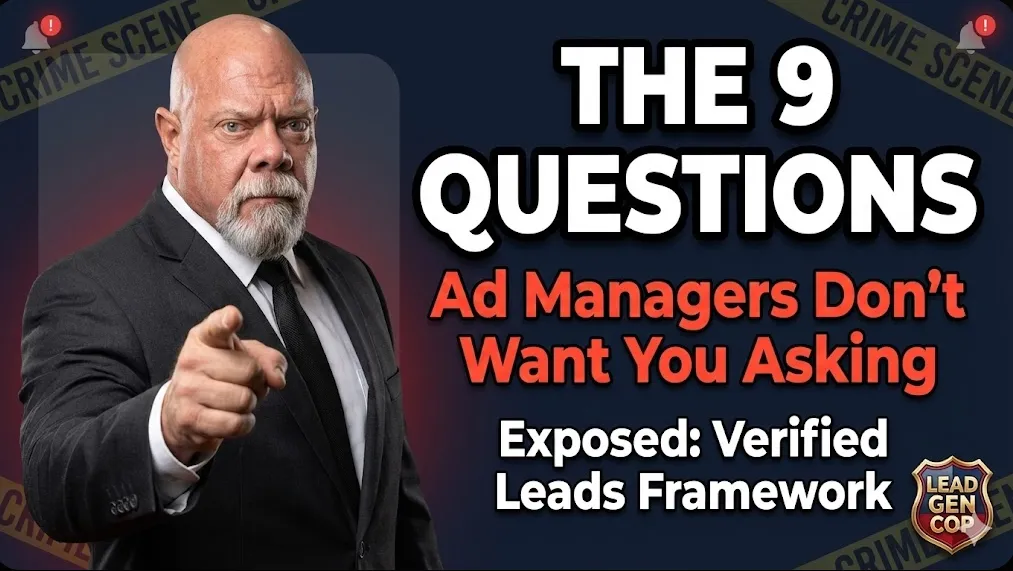
THE LEAD GEN COP'S COMPLETE FRAMEWORK: How to Never Get Scammed by an Ad Manager (And Hire the Right One Every Time)
TL;DR
Most lead generation is unverified garbage. Businesses pay for clicks, not leads. Mystery numbers. Bots. Tire kickers. The problem isn't advertising itself—it's the complete lack of verification and chain of custody. This post gives you the exact framework to audit any lead generation operation (including evaluating whether the person you hired is actually competent). It includes 9 critical questions that separate professionals from fraudsters, 4 components of a verified lead, the "evidence bag" weekly routine to stay honest with your metrics, and the three biggest traps business owners fall into. By the end, you'll know exactly what to demand from anyone managing your ad spend, and you'll be able to tell immediately if they're actually delivering verified outcomes or just vanity metrics.
OPENING: THE CRIME SCENE
[PHOTO PROMPT #1]: "Connor MacIvor in a serious, authoritative pose wearing a blazer with 'Lead Gen Cop' badge/logo visible. Professional office setting. Pointing at something off-camera with a stern, no-nonsense expression. Red/orange warning accent colors. Professional photography style."
Your phone rings.
It's someone asking if you do oil changes.
You're a roofer.
You just paid $50 for that lead.
Welcome to the lead generation industry.
Most lead generation operations sell hopes and impressions. They show you vanity metrics: cost per click, reach, impressions, brand awareness. But when your phone rings with someone who has zero intent to buy from you, those metrics mean absolutely nothing. That's not marketing. That's a crime scene.
Here's the hard truth I've learned after 20 years in law enforcement and now building verified lead systems: Most businesses buy leads the same way they'd buy a used car in a dark parking lot. No inspection. No history. No proof. Just vibes.
And it costs them tens of thousands of dollars per year.
I'm Connor MacIvor, aka the Lead Gen Cop. This post is the framework I use to audit every lead generation operation—including vetting the ad managers, consultants, and agencies who want to manage your budget. If you've ever hired an ad guy and ended up with a pile of junk leads, you're not alone. But after you read this, you will be.
SECTION 1: THE CORE PROBLEM - UNVERIFIED LEADS
Let me be direct: The real problem in lead generation isn't advertising. The real problem is no verification. No chain of custody. No accountability.
You're probably paying $8, $10, $12, $15 per lead right now. But are those leads actually leads? Or are they clicks from people with zero intent? Understanding what you should actually pay per lead requires understanding what you're actually getting.
The Google Ads Problem (And Why It's Getting Worse)
Back in the early days of Google Ads, there were individuals who would hammer the "inquiry" button on competitor's ads just to burn through their budget. Same IP address, same computer, same malicious intent.
Google eventually got smart and started identifying IP addresses. So what did these bad actors do? They hopped on different computers at their office. Logged in from different locations. Used VPNs. And kept clicking.
You're paying $20, $30, $40 per click, and it's not even a real lead. It's sabotage.
The deeper issue is that the real cost of bad lead quality compounds over time. One bad lead costs you money today. But it also costs you the opportunity cost of what a good lead could have produced.
The Meta/Facebook Problem (It's Better, But Not Perfect)
Facebook and Meta are slightly different because they pull data through lead forms instead of just tracking clicks. That's actually a step better. But the problem still exists—people click ads out of curiosity, fill out forms half-heartedly, and have zero intent to buy.
You get the contact info. You call. They say "I don't remember filling that out" or "I was just curious."
Cost per lead: $25. Real value: $0.
The Real Issue: No Standards
Every ad manager, agency, and freelancer has a different definition of what a "lead" is. Some count form fills. Some count phone clicks. Some count anyone who engaged with an ad.
There is no standardization. No verification. No proof.
This is exactly why transparency in ad pricing matters so much—because without it, you have no way to know if you're being scammed or getting value.
SECTION 2: WHAT ACTUALLY MAKES A VERIFIED LEAD
Before I show you how to hire the right person, you need to understand what a verified lead actually is.
[PHOTO PROMPT #2]: "Connor MacIvor holding a document or clipboard, examining it closely with a magnifying glass-type expression. Professional office background. Detail-oriented, inspecting carefully. Blue/green accent colors suggesting verification and trust."
A verified lead has four components. All four must be present. If any one is missing, it's not a verified lead.
Component #1: Proven Source
Where exactly did this lead come from? Not "we ran ads." Specifically: Meta, Google Ads, PPC, LinkedIn, organic, or partnership?
This matters because each channel has different fraud risks, different audience qualities, and different cost structures.
Why this matters: If you're paying $300/month for leads and you don't know which channel they're coming from, you can't optimize. You can't cut the bad channel and double down on the good one. You're flying blind.
Meta leads? Generally lower fraud rate because Facebook/Instagram connects to real accounts with real data. You'll occasionally get bots, but it's rare.
Google Ads? More vulnerable to click fraud. Someone clicks your ad from a different location every day, using a different computer, different VPN. That's not a lead.
LinkedIn? Good for B2B because you're targeting job titles and companies directly.
What to ask: "Can you tell me exactly which channels are producing my leads and break them down by volume and cost?"
If they can't answer this cleanly, stop talking to them.
Component #2: Proven Intent
What did the prospect actually request? What problem are they trying to solve?
Example: Someone fills out a form on your website and the form says "I need roof repair." That's proven intent. They identified a specific problem.
vs.
"I was just browsing" or "I clicked because I thought I could get a discount." That's not proven intent.
Why this matters: Intention is the difference between a $200 lead and a $2,000 lead. A roofing contractor would rather get 5 leads from people who specifically said "my roof is leaking" than 20 leads from people who just clicked because the ad looked interesting.
What to ask: "How are you capturing what the prospect actually needs or wants? Is it a form field? A conversation question? How do you verify their stated need is real?"
If they're just counting form fills without looking at what was filled in, they're not verifying intent. And that's often why your current lead gen is failing—not because of the ads, but because the intake process doesn't verify what people actually want.
Component #3: Proven Identity
Do you have real contact information? A real name, real phone number, real email?
Or is it "John Smith" with an email like "[email protected]"?
I've seen lead lists where the contact info is obviously fake. Generic names. Suspicious emails. Phone numbers that don't exist.
Why this matters: You can't follow up with a fake prospect. And following up is where you actually convert leads to customers.
What to ask: "How do you verify the contact information is real? Do you validate phone numbers? Do you send test SMS/emails to confirm they're real?"
A professional will have validation systems in place. SMS confirmation, email verification, phone number validation. They'll know which leads are real and which are suspect.
Component #4: Proven Chain of Custody
Can you tie the lead back to the specific ad, landing page, keyword, or creative that generated it?
This is critical for optimization. Because if you can't connect a lead to the source, you can't tell which ads are working and which are wasting money.
Example of strong chain of custody:
Prospect sees Google Ad #3 (specific headline, specific image)
Clicks through to Landing Page Variant B
Fills out form with UTM parameters that tag this specific ad
Lead enters your CRM with all source data attached
30 days later, they become a customer
You now know: Ad #3 → Landing Page B → $500 customer
You can see exactly what worked and scale it. In fact, seeing how we reduced cost per lead 40% in 90 days is essentially the story of getting this chain of custody right.
Example of broken chain of custody:
You run ads somewhere
People fill out forms
You get a CSV with names and phone numbers
You have no idea which ad produced which lead
You close some deals
You have no idea what actually worked
This is like trying to cook a recipe but not knowing which ingredient made it taste good.
What to ask: "Can you show me the complete source tracking for my leads? Can you trace each lead back to the exact ad, keyword, landing page, and creative that produced it?"
If they can't, they can't optimize. They're just guessing.
SECTION 3: THE 9 QUESTION FRAMEWORK FOR HIRING AN AD MANAGER
Now that you understand what verified leads are, here's how to evaluate anyone you're considering hiring to manage your ad spend.
I call this the "9 Question Framework." If they can answer all 9 cleanly and specifically, you're probably dealing with a professional. If they dodge, hedge, or give vague answers, you're about to get worked over.
[PHOTO PROMPT #3]: "Connor MacIvor in an interview-style setting, sitting at a table with a clipboard, pen poised, asking questions with an intense but fair expression. Professional interrogation-room aesthetic (but not aggressive). Serious, detailed-oriented energy."
Question #1: What's the Offer?
"What's your offer? Why should anybody care?"
This is the foundation. If an ad manager starts talking about targeting, algorithm optimization, and creative testing BEFORE they understand your offer, run.
A strong offer isn't "we do plumbing." That's not an offer. That's a service category. Everyone does plumbing.
A strong offer differentiates you. Examples:
"Same-day emergency service, $0 dispatch fee"
"Fixed pricing (no BS hidden charges)"
"24/7 availability"
"Military veteran owned"
"No service call charge for inspections"
A real ad manager will help you craft an offer that's compelling and defensible. They'll test different angles. They'll find the one that stands out. And they understand that how AI changes everything about lead generation is forcing us to be more specific and differentiated, not more generic.
Red flags:
They immediately suggest cutting your price to compete
They talk about "brand awareness" instead of offers
They say "everyone wants a good deal" (true, but irrelevant)
Green flags:
They ask about your unique positioning
They want to understand your service/product deeply
They talk about differentiation, not discounting
Question #2: What's the Cost Per Qualified Lead?
Not cost per click. Not cost per impression. Cost per qualified lead.
And they need to define what "qualified" means for your specific business.
Ask them: "What does a qualified lead look like for my business? Is it location? Budget? Timeline? Job type? Decision maker status?"
For a plumber: A qualified lead might be someone in Santa Clarita, has an actual plumbing problem (not just window shopping), is ready to hire within the next week, and has a budget of $200+.
For a real estate agent: A qualified lead might be someone in Santa Clarita Valley, owns a home (or is looking to buy), is actively considering selling/buying in the next 3 months, and is motivated.
For a B2B service: A qualified lead might be a business owner in a specific industry with $1M+ revenue, located in your service area, and has mentioned the specific problem you solve.
If they can't define qualified for your business, they can't optimize for it.
Every good ad manager will have this conversation. If they gloss over it, they're just buying volume without caring about quality. And that's the hidden cost of done-for-you lead generation that most people don't realize until they're already bleeding money.
Question #3: How Do You Track Every Lead Back to Source?
This is the chain of custody question.
They should explain:
UTM parameters on all links
Form tracking with source attribution
Call tracking numbers for phone leads
Landing page variant tracking
Keyword search term reporting (for Google Ads)
Pixel or API integration so you can see the complete journey
Real answer: "We use UTM parameters on every link so we can track which ad, keyword, and landing page produced each lead. We integrate with your CRM so the source data is attached to every lead record. We also use call tracking numbers so even phone clicks are attributed correctly."
Vague answer: "We track everything in our dashboard." (They can't actually show you the data clearly)
Bad answer: "We use call tracking and that's enough." (You can't track digital leads properly, and you have no idea which ads are working)
Question #4: What Happens in the First 14 Days?
This is the setup and testing phase. They should have a specific plan:
Days 1-2: Account setup, pixel installation, CRM integration
Days 3-5: Landing page creation, form building, ad copy development
Days 6-10: Creative testing, ad variant setup, call script development
Days 11-14: Launch, monitor, collect initial data, prepare for optimization
This ties directly to the 5-step AI lead generation system we use, where step 1 is always diagnosis and setup.
What they should do: Multiple ad variations, multiple landing pages, different messaging angles. They're testing to find what works.
Red flags:
"We'll just set it and see what happens" (Gambling, not strategy)
"It takes 30 days to optimize" (Lazy. Should be dialed in by day 14)
No mention of testing or iteration (They don't know what they're doing)
Green flags:
Specific day-by-day timeline
Multiple variations being tested
Clear milestones for each phase
Focus on data collection in week 1-2
Question #5: How Do You Prevent Junk Leads?
This is where they demonstrate their verification system.
They should mention:
Better ad copy - specific, compelling, not vanilla. Vanilla ads attract low-intent people.
Landing page optimization - clarity about what you offer, not generic
Form qualification - the form itself asks qualifying questions (location, budget, timeline)
SMS/Email confirmation - verify the contact info is real
Intent filtering - routing leads based on what they actually requested
Geographic controls - only showing ads to people in your service area
Schedule controls - only scheduling appointments during times you can actually service
Example: A plumber in Santa Clarita should only get leads from people in Santa Clarita, Canyon Country, Newhall, Valencia, and Saugus. Not from people across Southern California. Not from people 2 hours away.
If they can't explain their filtering system, you'll get garbage leads. This is core to understanding what makes a good fit for Southern California Verified Leads—we're selective because quality beats quantity every time.
Question #6: What's Your Creative Testing Process?
On Meta especially, creative is king. The ad itself matters more than the targeting.
They should explain:
Multiple hooks - testing different value propositions
Multiple formats - short video, static image, carousel
Different angles - price guarantee, speed guarantee, quality guarantee, trust/authority
Rotation and iteration - testing weekly, not just running one ad for 30 days
If they run the same ad for 30 days and call it optimization, you're funding their learning curve.
Good answer: "We test 3-5 different ad variations per week, monitor performance daily, rotate winners vs. underperformers, and update creative based on what's resonating."
Bad answer: "We run one ad and let it work for a month to collect data."
See real client results showing how we went from 45 CPL to 28 in 90 days as a case study of what proper creative testing looks like.
Question #7: How Do You Handle Google PPC Differently Than Meta?
This is the channel-specific strategy question. If they treat all channels the same, that's a red flag.
Google Ads (PPC):
Captures existing intent (people actively searching for solutions)
Multiple formats: Search ads, Performance Max, YouTube ads
Intent-based, keyword-based
Works well for immediate need (emergency plumber)
Usually higher cost per click but higher intent
Meta (Facebook/Instagram):
Creates demand (showing ads to people not actively searching)
Multiple formats: Feed ads, Reels, Stories, Carousel
Interest-based, demographic-based targeting
Works well for awareness and lead volume
Usually lower cost per lead but requires more nurturing
LinkedIn:
B2B targeting (job titles, company size, industry)
Account-based approach
Good for higher-ticket services
Premium pricing
Understanding this distinction is critical because each channel requires different optimization, which is why how AI changes everything about lead generation isn't just about AI—it's about being smarter about channel selection and testing.
A professional will explain: "Google is better for capturing high-intent traffic. Meta is better for demand creation and volume. We run both but optimize them differently. Google we watch constantly because click-through means intent. Meta we focus on creative and audience refinement."
An amateur will say: "We optimize all channels the same way."
Question #8: What's Your Reporting Cadence and What's Included?
They should provide:
Lead volume - how many total leads
Verified vs. unverified - what percentage are actually qualified
Cost per lead - total spend ÷ leads
Lead quality scores - which leads convert better
Conversion rates - leads to appointments/customers
Close rates - if tracked
Ad performance breakdown - which ads/keywords produce best leads
Landing page performance - which pages convert best
What changed and why - month-over-month analysis
Critical: Reports should NOT just be screenshots of ad dashboards. If they're showing you dashboards, that's performance theater. They need to show you actual business outcomes.
Good report: "We generated 47 leads last month. 34 were verified (72%). Cost per lead was $38. 12 became appointments (25% conversion). 3 closed (25% appointment-to-close). Total revenue: $8,400. Ad spend: $1,785. ROI: 370%."
Bad report: "Your ads got 5,000 impressions and 127 clicks."
Question #9: What Do You Need From Me to Exceed?
This is the real talk question. Professional ad managers will be honest about what they need.
They'll say things like:
"I need someone answering the phone." Speed to lead is critical. If you're running ads but nobody's picking up the phone, leads go to competitors. It takes 30-60 seconds of no answer for a prospect to call someone else. This is why AI missed call text back systems matter so much—they ensure no lead goes unanswered.
"I need you to close." They can deliver leads, but you have to do your job closing them. If they're closing 5% and they could be closing 25%, that's on you, not the ads.
"I need access to your CRM." So they can see outcomes and optimize based on what's actually converting.
"I need you to honor the offer." If the ads promise same-day service, you have to deliver same-day service. If ads promise fixed pricing, you have to stick to it.
"I need staff." If you're getting 50+ leads/month and you're a solo operator, you'll miss calls and leads will go to competitors. This is where solutions like AI voice agent lead qualification come in—they help you handle higher volume.
A real professional will be honest: "I can deliver leads all day long. But if you don't have someone answering the phone within 2 minutes, and you don't have the capacity to service them, they'll go to your competitor. That's on you, not me."
SECTION 4: THE THREE BIGGEST TRAPS BUSINESS OWNERS FALL INTO
These are mistakes I see constantly. Know them so you don't become a victim.
[PHOTO PROMPT #4]: "Connor MacIvor with a serious, warning expression, hand raised in a stop gesture. Dark tones. Alert, protective energy. Professional warning/caution aesthetic."
Trap #1: Paying for Traffic Instead of Outcomes
Traffic isn't a goal. Revenue is.
You're paying $2,000/month for ads, and your ad manager is bragging about "getting you to page 1 of Google" or "reaching 100,000 people."
So what?
If those 100,000 people have zero interest in what you offer, you've wasted money. And if you're paying for traffic instead of outcomes, you're essentially paying to deliver leads to your competitors.
The wrong mindset: "We drove 10,000 people to your website!"
The right mindset: "We generated 25 qualified leads that matched your criteria, at $72 cost per lead, with a 24% conversion to appointments."
The difference: One is vanity. One is business.
This is covered extensively in our guide on the cost of not getting lead generation right—because vanity metrics are expensive when you dig into the real cost.
How to avoid this trap: Always measure outcomes, not traffic. Leads, appointments, customers, revenue. Not impressions, clicks, or reach.
Trap #2: Paying Ads When You Can't Actually Deliver
This is brutal. You launch ads. They work great. Leads start coming in. Phone is ringing.
Then what?
If you don't have the staff, systems, or capacity to actually serve those leads, they go to competitors. You've just paid money to develop your competitors' customer base.
Real scenario: A contractor launches Google Ads. Starts getting 8-10 calls/day (great!). But he's a solo operator. He can handle 2-3 jobs/day. Calls 4-7 go to voicemail. Never get called back. Those leads call another contractor and hire them instead.
The math: 8 calls/day × $75 cost per call = $600 lead spend/day. 4 of those leads go to competitors. $300/day wasted.
In a month: $7,200 wasted on leads you never followed up with.
This is why understanding the capacity update and which industries are still open matters—because scaling ads before scaling your team is a recipe for disaster.
How to avoid this trap: Before you scale ads, make sure you have the capacity to deliver. Staffing, systems, availability. If you're a solo operator, cap your lead volume to what you can actually handle. It's better to get 2 qualified leads you close than 8 leads you miss.
Trap #3: Confusing Marketing With Lead Processing
Here's a hard truth: Many businesses don't have a lead problem. They have a follow-up problem.
Your ads are fine. Your lead quality is fine. You're getting leads.
But your intake process is sloppy. Your follow-up is slow. Your systems don't work. Your people don't answer emails/calls promptly. Leads fall through cracks.
So you blame the ad guy.
Real scenario: Real estate agent gets 60 leads/month from Facebook ads. Books 15 showings (25% conversion). But 4 agents are doing the follow-up, none of them coordinated. Some leads get called 3 times in the same day. Some never get called. Some get transferred around. Showup rate is 40%.
If the agent instead had a good intake process (centralized, coordinated, CRM-based follow-up), that 25% conversion could become 60%. Same leads. Better processing.
The lesson: Don't just hire someone to buy leads. Make sure your internal systems are solid enough to actually process them. This is exactly what why your current lead gen is failing and how we fix it addresses—because the problem is usually internal, not external.
Browse our mistakes and solutions category to see more examples of how good processes beat good ads every time.
SECTION 5: THE EVIDENCE BAG WEEKLY ROUTINE
This is how you stay honest with your metrics and catch problems before they become expensive.
Every week, you do a review. I call it the "evidence bag" method because we're gathering evidence about what's actually working.
[PHOTO PROMPT #5]: "Connor MacIvor sitting at a desk reviewing documents, spreadsheets, and analytics on a computer screen. Focused, detail-oriented expression. Multiple screens showing data. Professional analyst/auditor energy."
Step 1: Review Top Lead Sources (By Quality, Not Quantity)
Not "which channel gave us the most leads?" but "which channel gave us the best leads?"
A lead that closes is worth 10 leads that don't. So quality > quantity.
What to look at:
Which channel produced leads with 30%+ conversion to appointment?
Which channel produced leads with 20%+ appointment-to-close rate?
Which channel's leads had the highest customer lifetime value?
If Meta is giving you 50 leads but only 2 close, while Google Ads is giving you 20 leads but 6 close, you know Google is the winner. Double down there.
Step 2: Identify the Exact Ads and Keywords Producing Best Leads
Which specific ad? Which specific headline? Which specific keyword?
Track this weekly so you can:
Kill underperformers immediately
Scale winners
Test variations of winners
This is not a monthly review. This is weekly.
Step 3: Monitor Landing Page Conversion Rates
If your landing pages are converting 3% of visitors to leads, but industry standard is 8%, you have a problem.
Not with ads. With pages.
Review:
Which pages are converting best?
Which pages are underperforming?
What's different about the high-converters?
Step 4: Review Call Recordings or Lead Notes
What did prospects actually say? Did they match the ad? Did they mention the specific offer?
If prospects are saying "I just called to see what you charge" but your ad is about emergency service, your messaging is misaligned.
Listen to calls. Read notes. Understand what's actually happening.
Step 5: Track Follow-Up Metrics
How fast did we respond? (Ideal: <5 minutes)
How many follow-up attempts? (Ideal: 3-5 over 3 days)
What was the response rate?
Speed to lead is absolutely critical. If you're calling back after 2 hours, leads have already hired someone else. This is why understanding what you should actually pay per lead requires understanding your follow-up speed—because a $50 lead that never gets called back is worth $0.
The Weekly Output
You spend 90 minutes/week reviewing. You come away with:
Which channels to scale
Which channels to pause
Which ads are working
Which landing pages to improve
Whether your follow-up is fast enough
Whether your lead quality is good
Then you take action immediately.
SECTION 6: THE COMPLETE SYSTEM - HOW VERIFIED LEADS ACTUALLY WORK
[PHOTO PROMPT #6]: "Connor MacIvor standing in front of a large system diagram/flowchart showing the complete lead generation ecosystem with arrows connecting different channels (paid, organic, partnerships). Confident, authoritative pose. Teaching/explaining energy."
Now that you understand how to verify and audit leads, here's how to structure a complete system that actually produces qualified outcomes.
It has three components:
Component 1: Paid Acquisition (Fast, Direct)
You pay money, you get leads quickly.
Meta Ads (Facebook/Instagram):
Best for demand creation
Reaches people not actively searching
Cost: $15-$40 per lead
Timeline: 3-7 days to first leads
Best for: Real estate, service volume, insurance
Google Ads (PPC):
Best for capturing high-intent traffic
Reaches people actively searching
Cost: $40-$120 per lead
Timeline: 1-3 days to first leads
Best for: Emergency services, high-intent industries
LinkedIn Ads (B2B):
Best for business decision-makers
Reaches by job title, company, industry
Cost: $80-$200 per lead
Timeline: 3-5 days to first leads
Best for: B2B services, recruiting, high-ticket
Component 2: Organic Systems (Slow, Compounding, Long-Term)
You build content, systems, and authority that generates leads without paid spend. This is covered in depth in our lead generation strategy category where we explore organic tactics in detail.
Blog content structured for AEO/AIEO (5,000-8,000 word posts answering buying questions)
Google Business Profile optimization with 100+ reviews
YouTube content building authority and trust
Email nurture sequences keeping interested prospects warm
Local citations and structured data helping you show up in local searches
Timeline: 6-12 months to meaningful volume Cost: $2,000-$5,000/month (content creation, optimization) Lifetime value: Extremely high (leads come for years)
Component 3: Partnership Procurement (Warm, Pre-Trusted)
You build relationships with complementary businesses who refer you.
Real estate agents + mortgage brokers + home inspectors + contractors
Dental offices + cosmetic surgeons + smile designers
Personal trainers + cosmetic surgeons + physical therapists
Marketing agencies + software developers + design firms
Partnerships come pre-trusted because they're referrals from people prospects already trust.
Why this matters: A lead from a partner has 2-3x higher close rate than a cold lead. And cost is near-zero (reciprocal referrals or small commissions).
SECTION 7: GEO-SPECIFIC GUIDANCE FOR SANTA CLARITA VALLEY BUSINESSES
Everything above is universal. But here's what's specific to Santa Clarita Valley:
Your Market:
Santa Clarita proper
Saugus (north)
Canyon Country (northeast)
Valencia (southwest)
Newhall (central)
Castaic (on the edge)
Your Competition:
Limited (you're in a secondary market, not LA proper)
Most large agencies ignore Santa Clarita
Opportunity: Local expert can dominate
Your Advantage:
Build "Southern California Verified Leads" as the local authority
Use geo-specific case studies (other SCV businesses)
Build partnerships locally (other SCV service providers)
Show up for "Santa Clarita" + your service type
What to Ask Your Ad Manager:
"Are you geofencing properly to Santa Clarita and surrounding areas?"
"Are you excluding areas outside my service radius?"
"Can you show me leads broken down by city (Santa Clarita vs. Saugus vs. Valencia)?"
If they're sending you leads from Palmdale or Victorville when you only service Santa Clarita, that's waste.
Learn more about what works in our conversion and sales category where we document specific SCV business results.
FAQ SECTION
Q: What if my current ad manager can't answer these 9 questions well?
A: You probably need a new ad manager. These aren't trick questions. Professionals answer them clearly. If they dodge or give vague answers, they either don't know what they're doing, or they're hiding something.
Q: Can I do this myself, or do I need to hire someone?
A: You can learn to do it yourself, but it requires time and ongoing education. The advertising platforms change constantly. Ad costs fluctuate. Best practices evolve. If you have 10+ hours/week to dedicate to learning and managing, go for it. Otherwise, hire someone. Just make sure they can answer these 9 questions.
Q: How much should I expect to spend on ads before I see results?
A: Depends on industry and market. But generally:
First $1,000: Data collection phase (testing what works)
$1,000-$5,000: Optimization phase (scaling what's working, killing what's not)
$5,000+: Growth phase (predictable results, scaling up)
If someone promises results on $500/month budget in a competitive market, they're either lying or doing low-quality volume.
Q: What if I get good leads but can't close them?
A: Then you have a sales problem, not a lead problem. This is where Question #9 comes in. A good ad manager will tell you "I can deliver leads, but you have to be able to close." If you're closing 5% and your industry standard is 25%, that's on you.
Get sales training. Get a better salesperson. Improve your offer. Improve your follow-up speed. But don't blame your ads. Check out our conversion and sales category for tactics on improving your close rate.
Q: Should I use an agency or a freelancer?
A: Depends. Agencies are usually more professional (they have systems, backup staff, accountability). Freelancers are usually cheaper and more flexible.
Agency pros: Established processes, dedicated account manager, backup support, higher accountability Agency cons: More expensive, less personalization, might not understand your specific market
Freelancer pros: Cheaper, more personalized, flexible Freelancer cons: Less accountable, might take vacation and abandon you, might lack systems
Either way, they should be able to answer the 9 questions.
Q: How do I know if I'm getting ripped off?
A: Ask these questions:
Can they prove source attribution?
Are they testing multiple variations?
Are they optimizing weekly (not monthly)?
Are they transparent about conversion rates?
Are they honest about what they need from you?
If they can't answer these, you're probably getting ripped off.
SECTION 8: YOUR ACTION PLAN (NEXT 30 DAYS)
If you're currently working with an ad manager:
This week: Ask them the 9 questions. Record their answers. See if they can answer cleanly.
Next week: Implement the "evidence bag" weekly routine. Start tracking quality, not just volume.
Week 3: Review conversion rates. If leads aren't converting, is it the leads or your follow-up?
Week 4: Make a decision: Keep them if they're good, replace them if they're not.
If you're not currently working with an ad manager:
This week: Define your offer clearly. What's unique about you? Why should someone choose you over competitors?
Next week: Set up Google Ads account and Meta Ads account. Start with small budgets ($500-$1,000 total). Test messaging.
Week 3: Collect data. Which ads are getting clicks? Which landing pages are converting?
Week 4: Scale what's working. Cut what's not. Plan for month 2.
CLOSING: THE LEAD GEN COP'S PROMISE
I spent 20 years in law enforcement because I believe in protecting people. I'm spending the next 20 years building verified lead systems because I believe business owners deserve better than the fraud and nonsense currently happening in the industry.
You don't have to accept garbage leads. You don't have to wonder if your ad spend is working. You don't have to feel stupid for not knowing what's happening with your money.
Ask the 9 questions. Demand the evidence. Stay honest with your metrics.
That's how you win.
Ready for verified leads that actually work? Check out what makes a good fit for Southern California Verified Leads to see if we're a match. Or explore our current capacity and which industries are still open.
I'm Connor MacIvor, the Lead Gen Cop. When you're ready for verified leads, I'm here.
