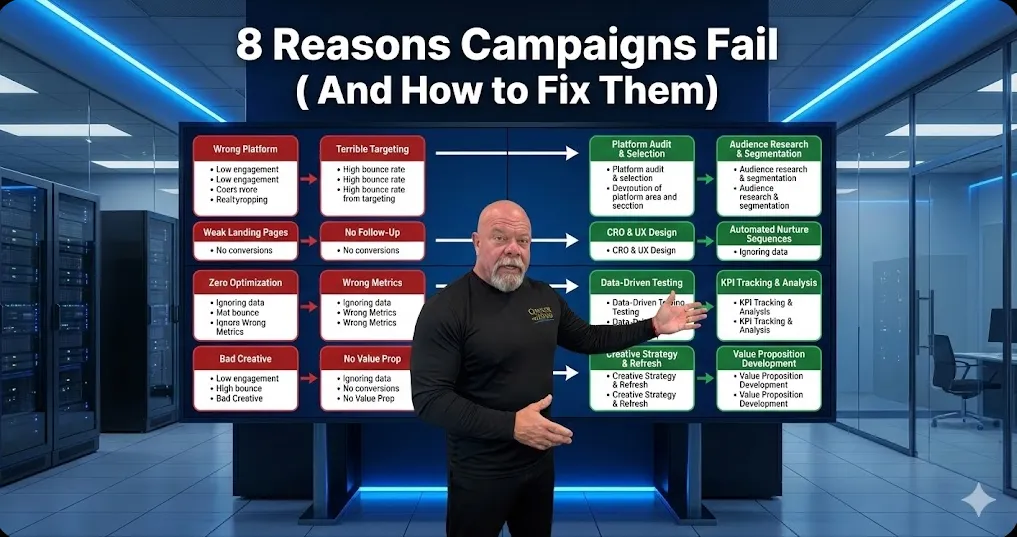
Why Your Current Lead Gen Is Failing (And How We Fix It)
TL;DR
Most lead gen campaigns fail not because the idea is bad, but because of execution mistakes. We see the same problems over and over: wrong platform, terrible targeting, weak landing pages, no follow-up, zero optimization. This post identifies the 8 most common failure points and shows exactly how we fix them. If your current lead gen is struggling, one (or more) of these is the culprit.
Introduction: Why Good Intentions Fail
You started a lead gen campaign because you believed in it.
You picked a platform (Google Ads, Facebook, whatever).
You set a budget.
You waited for leads to roll in.
...and either nothing happened, or the leads came but nobody converted.
This is the most common frustration we hear: "We tried lead gen and it didn't work."
But here's the truth: Lead gen doesn't fail. Execution fails.
There's a difference.
This post identifies the 8 biggest execution mistakes we see. Read through. See which ones apply to you. Then we'll talk about fixing them.
Q&A: Understanding Why Campaigns Fail
Q: Is lead gen just not viable for my business?
A: Probably not. Lead gen works for almost every service business. The problem is usually how it's being done, not whether it's possible.
Q: How do I know if my campaign is actually failing or just slow?
A: Give it 30 days of data. A healthy campaign should show: increasing leads, stable or declining CPL, initial conversation rates around 40%+. If none of those are happening by day 30, something's wrong.
Q: Can campaigns fail even if I'm doing "everything right"?
A: Yes, if "everything right" is based on guesses instead of data. Most people think they're optimizing when they're actually just making random changes.
Q: Is my business too niche for lead gen?
A: Almost certainly not. We've done lead gen for HVAC, plumbing, electricians, dentists, real estate, mortgage, CPAs, therapists, auto repair, appliance repair, and more. If there's demand for your service, lead gen can work.
Failure Point #1: Wrong Platform (Trying to Fish in an Empty Pond)
The Problem
You're advertising where your customers aren't.
Common scenario:
You run Google Search Ads (high CPL, low volume)
You should be on Facebook/Meta (lower CPL, better targeting)
Or you're on Facebook but need Google + TikTok
Or you're on all platforms indiscriminately (no focus)
How It Shows Up
Very high CPL ($100+) with low contact rate
Tons of traffic, but nobody converts
Wrong demographic clicking ads (wrong audience entirely)
Campaign costs exploding with no corresponding lead increase
Why This Happens
You picked a platform based on what you've heard about, not data.
"Google is where people search for services" — true, but Google Ads are expensive because EVERYONE advertises there.
"Facebook is cheap" — true, but only if you target right. Badly targeted Facebook ads are useless.
How We Fix It
We run a platform audit:
Where is your ideal customer?
HVAC emergency repairs → Google (people searching "emergency furnace repair")
Real estate browsing → Facebook/Instagram (lifestyle targeting)
Mortgage refinancing → Google (search intent)
Professional services → LinkedIn (B2B targeting)
Where are your competitors?
If everyone is on Google Ads, we go to Facebook (less competition, lower cost)
If everyone is on Facebook, we go to Google or TikTok
Avoid crowded platforms when possible
Test each platform with small budget
$300/month test on each platform for 30 days
See which drives the best quality leads
Double down on winner, pause loser
Result
Right platform = 30-50% lower CPL + better lead quality.
Failure Point #2: Terrible Targeting (Casting Too Wide a Net)
The Problem
You're reaching millions of people, 99% of whom will never buy from you.
Common mistakes:
Targeting "anyone interested in home services" (millions of people, mostly not ready to buy)
Targeting entire metro area (wrong neighborhoods, wrong demographics)
No behavioral targeting (not filtering for high intent)
Broad keywords instead of specific keywords
How It Shows Up
High CPL ($50+)
Lots of leads, but mostly low-quality
Contact rate 20-30% (should be 60%+)
Leads that are clearly wrong fit (renters, out of service area, different service)
Why This Happens
You assume everyone is a potential customer.
Technically they are. But practically, targeting everyone is targeting no one.
Specificity = quality. Broad = waste.
How We Fix It
We narrow targeting obsessively:
Geographic Precision:
Not "California" or even "Los Angeles"
Specific 10-15 mile radius from your location
Further narrowed by neighborhood demographics
Exclude areas with low demand
Demographic Targeting:
Age (usually 35-65 for home services)
Income (can afford your service)
Homeownership status (not renters)
Family status (homeowners with kids = higher repair rates)
Behavioral/Intent Targeting:
People searching "emergency HVAC repair" (high intent)
Not people searching "HVAC information" (research phase)
People who visited HVAC retailer websites
People with past home improvement purchases
Look-alike audiences (similar to your best customers)
Keyword Targeting (if using Google):
"Emergency furnace repair" (high intent)
Not "furnace information" (low intent)
"Furnace repair near me" (local intent)
Not "how to fix furnace myself" (DIY intent)
Result
Narrow targeting = 30-40% lower CPL + 200% higher conversion rate.
It's counterintuitive, but smaller audience = better results.
Failure Point #3: Weak Landing Pages (Highway to Nowhere)
The Problem
Your ads drive traffic, but the landing page doesn't convert.
Common mistakes:
Sending all traffic to homepage (not optimized for conversion)
Generic landing pages that don't match ad message
Too much text, too many options, confusing CTA
Forms asking for too much information (10+ fields = abandonment)
No trust signals (no testimonials, no credentials, no proof)
How It Shows Up
Decent CPL but very low conversion rate (2-3% instead of 10-15%)
High bounce rate (people leave immediately)
Forms started but not completed
No mobile optimization (half your visitors are mobile)
Why This Happens
You assume your website sells. It doesn't.
Your website is for brands and navigation.
A landing page is specifically designed for conversion from a cold visitor.
They're different animals.
How We Fix It
We build conversion-focused landing pages:
Match Ad to Landing Page:
Ad says "Emergency Service" → Landing page says "Emergency Service" (in hero)
Ad says "Save Money" → Landing page leads with cost savings
Matched messaging = 300% higher conversion
Minimal Friction:
Single goal (book appointment or get quote)
Form with 3-5 fields max (not 12)
Clear CTA button (contrasting color, compelling text)
Stripped-down design (no nav menu, no distractions)
Trust Signals:
Customer testimonials (with photos)
Credentials (licensed, insured, certified)
Guarantees (satisfaction guarantee, money-back guarantee)
Social proof (X+ happy customers, years in business)
Trust badges (BBB, Google reviews, ratings)
Mobile Optimization:
50%+ of traffic is mobile
Page must load fast on mobile
Form must be easy to fill on small screen
CTA button must be thumb-friendly
Speed:
Page loads in <2 seconds (people abandon slow pages)
Optimized images
Minimal code bloat
Result
Good landing page = 200-300% higher conversion rate.
If you're getting 2% conversion now, optimized landing page gets you to 6%+.
Failure Point #4: No Follow-Up System (Leads Go to Waste)
The Problem
Leads come in, but nobody follows up, or follow-up is too slow.
Common mistakes:
No immediate response (contacting lead after 24+ hours)
Single contact attempt (calling once then giving up)
No SMS follow-up (relying only on phone calls)
No nurture sequence (leads who aren't ready drop into void)
No lead assignment (leads get lost in inbox)
How It Shows Up
Lots of leads but low conversion rate
Sales team says "these leads aren't good"
People say "I already called someone else"
Leads never respond to follow-up
Why This Happens
Time kills deals.
If someone fills out a form at 2 PM and you call at 3 PM the next day, they've already called 3 other contractors.
The person who follows up in 5 minutes wins.
How We Fix It
We build follow-up systems:
Immediate Response:
SMS sent within 5 minutes ("Got your request, here's next step")
Email sent within 30 minutes (detailed information)
Phone call within 1 hour (if possible)
Multiple Contact Methods:
Don't just call (some people prefer text/email)
SMS + phone call + email = 80% contact rate
Keep trying: 3-5 attempts over 3-5 days
Lead Assignment:
Leads routed automatically to right salesperson
Each lead assigned within minutes of submission
No leads getting lost in inbox limbo
Nurture Sequences:
For leads not ready to buy immediately
Weekly emails with valuable information
Keep your business top-of-mind
Often converts 30-60 days later
Calendar Integration:
Easy booking link (not "call and schedule")
Reduces friction for appointment booking
Automatically confirms/reminds
Result
Good follow-up system = 100-200% higher conversion rate.
If you're converting 5 leads per 100, optimized follow-up converts 10-15.
Failure Point #5: Zero Optimization (Set It and Forget It)
The Problem
Campaign ran fine month 1, then performance declined.
Common mistakes:
Launching campaign, then never touching it
No creative rotation (same ads for 6+ months)
No audience refinement (still reaching everyone)
No budget reallocation (equal spending on unequal performers)
No testing (never A/B test anything)
No monitoring (CPL goes up $10 and you don't notice for 3 weeks)
How It Shows Up
CPL was good month 1, now high month 3+
Performance decline = you're getting "bad leads"
Creative fatigue (people saw ads so many times they ignore them)
No data to show what's working
Why This Happens
Campaigns need maintenance.
Like a car, you can't buy a car and never change the oil.
Same with lead gen.
How We Fix It
We build optimization schedules:
Daily:
Monitor CPL for spikes
Check lead volume for drops
Alert if anything unusual
Weekly:
Review top-performing ads
Review top-performing audiences
Pause underperformers
Launch 2-3 new ad variations
Bi-Weekly:
A/B test landing page changes
Refine audience targeting
Adjust bid strategies
Monthly:
Comprehensive performance review
Reallocate budget to winners
Seasonal adjustments
Strategic planning
This isn't complicated. It's just systematic.
Result
Continuous optimization = 20-40% CPL reduction over 90 days.
Campaigns that optimize outperform campaigns that don't by miles.
Failure Point #6: Wrong Metrics (Optimizing for the Wrong Goal)
The Problem
You're measuring the wrong thing.
Common mistakes:
Optimizing for leads (not conversions)
Tracking CPL but not conversion rate
Counting form fills (many are garbage)
No ROI calculation (don't know profit per lead)
No contact rate tracking (don't know if leads are real)
How It Shows Up
Tons of leads but low conversion
High CPL but good conversion (might be worth it, but you don't know)
Can't explain why campaign is failing
Making optimization decisions with incomplete data
Why This Happens
You don't know what to measure.
Most people think "leads = success."
But a $10 lead that converts is better than a $5 lead that doesn't convert.
How We Fix It
We track the right metrics:
Lead Quality Metrics:
Contact rate (% of leads that pick up phone or respond): Should be 60%+
Qualification rate (% that are actually interested): Should be 40%+
Service-match rate (% in service area, right service): Should be 80%+
Conversion Metrics:
Appointment rate (% who book): Should be 15-25%
Close rate (% who become customers): Should be 5-20% depending on industry
Revenue per customer: What's their lifetime value?
Cost Metrics:
Cost per lead (ad spend ÷ leads)
Cost per contact (ad spend ÷ contacted leads)
Cost per appointment (ad spend ÷ appointments)
Cost per customer (ad spend ÷ customers closed)
ROI:
Revenue generated ÷ cost = ROI multiple
If you spend $1,000 and make $5,000 profit, ROI is 5x
Result
Right metrics = data-driven decisions = 30-50% better performance.
You can't improve what you don't measure.
Failure Point #7: Bad Ad Creative (Blending Into the Noise)
The Problem
Your ads are boring, generic, or unclear.
Common mistakes:
Same message as competitors
Generic benefit statements ("quality service")
No urgency or compelling reason to click
Poor visual design or low-quality images
Same 2 ads running for months (ad fatigue)
No variation in messaging angles
How It Shows Up
High cost per click (nobody's clicking)
Low click-through rate (ads aren't compelling)
Lots of clicks but few conversions (wrong promise)
Ad fatigue (CTR declining over time)
Why This Happens
You're competing with 1,000 other ads for attention.
Generic doesn't win. Specific wins.
"Quality HVAC Service" vs. "AC Broken? We're Here Today" — which would you click?
How We Fix It
We create compelling creative:
Specific Benefits:
Not "quality service"
"Same-day repair" or "Emergency service available"
Specific to pain point, not generic
Emotional Triggers:
Urgency: "Furnace won't turn on?"
Relief: "We handle the stress"
Trust: "25 years, family-owned"
Savings: "Cut energy bills 30%"
Multiple Variations:
Not 2 ads, but 12-20 variations
Different angles (emergency, cost, quality, speed)
Different visuals (photos, video, testimonials)
Different CTAs (book now vs. get quote vs. learn more)
Testing:
Launch all variations
See which resonates
Double down on winners
Rotate out underperformers
Creative Rotation:
Refresh ads every 30-45 days
Prevent ad fatigue
Keep messaging fresh
Result
Good creative = 50-100% higher CTR + 30-50% lower CPL.
Creative is make or break.
Failure Point #8: No Clear Value Proposition (Why Should They Choose You?)
The Problem
People don't understand why they should pick you over competitors.
Common mistakes:
No differentiation (same as everyone else)
No clear positioning (can't summarize what you do in one sentence)
No specific promise (generic "quality" or "service")
No proof points (no testimonials, no credentials, no results)
Talking about features instead of benefits
How It Shows Up
Leads saying "I already called someone else"
High CPL but low conversion (can't justify cost)
Indifferent response to your pitch
Losing to cheaper competitors
Why This Happens
You think everyone knows you're good. They don't.
People don't know you. They don't know your reputation.
You have to tell them why they should pick you.
How We Fix It
We develop clear positioning:
What Are You?
Not "HVAC contractor"
"Same-day emergency HVAC service in SCV"
Specific + location + promise
Why Should They Pick You?
25 years in business
Licensed and insured
Same-day service guarantee
Transparent pricing
500+ happy customers
What Do You Promise?
Not "quality repairs"
"Your furnace working within 2 hours or free service"
Specific, measurable promise
Proof:
Testimonials (real customers, real stories)
Reviews and ratings
Awards or certifications
Years in business
Number of customers served
Benefit-Focused Messaging:
Not "we have the newest equipment"
"Our newest equipment saves you 30% on energy bills"
Focus on what customer gets, not what you have
Result
Clear positioning = 50-100% higher conversion rate + ability to charge premium prices.
When people know exactly why you're different, they pick you.
The 8 Failure Points: Summary Checklist
Failure PointSymptomFixWrong PlatformHigh CPL, wrong audienceTest multiple platforms, find the right oneTerrible TargetingTons of leads, low qualityNarrow to high-intent audiencesWeak Landing PagesLow conversion rate (2-3%)Build conversion-focused landing pagesNo Follow-UpLeads go to wasteImplement automated follow-up systemZero OptimizationPerformance declines over timeSchedule weekly optimization reviewsWrong MetricsMeasuring leads instead of ROITrack contact rate, conversion rate, cost per customerBad CreativeLow CTR, high CPLCreate 12+ variations, test continuouslyNo Value PropCan't differentiate, losing to competitorsDevelop clear positioning and messaging
Frequently Asked Questions
Q: Can campaigns fail even if all 8 of these are fixed?
A: Rarely. If all 8 are optimized, campaigns almost always succeed. But external factors (market saturation, seasonal changes, economic downturn) can slow growth.
Q: How much will fixing these cost?
A: Depends on what's broken and how much work it takes. That's why we audit first. Could be $1,500 setup (if starting fresh) to $5,000+ (if redesigning everything).
Q: Can I fix these myself?
A: Some yes, some no. Wrong platform and terrible targeting you might diagnose yourself. But weak landing pages, no follow-up, zero optimization, bad creative, and wrong messaging require expertise most business owners don't have.
Q: How long until campaigns work after fixing these?
A: 30-60 days. You need a month of data to see what's working.
Summary: Campaigns Don't Fail. Execution Does.
If your current lead gen is struggling, it's not that lead gen doesn't work.
It's that one (or more) of these 8 execution mistakes is sabotaging you.
Identify the problem. Fix it. Results follow.
Ready to Diagnose Your Campaign?
Schedule Your Strategy Call — We'll identify which of the 8 failure points are affecting YOUR campaign.
Or Apply Now if you want us to fix it.
