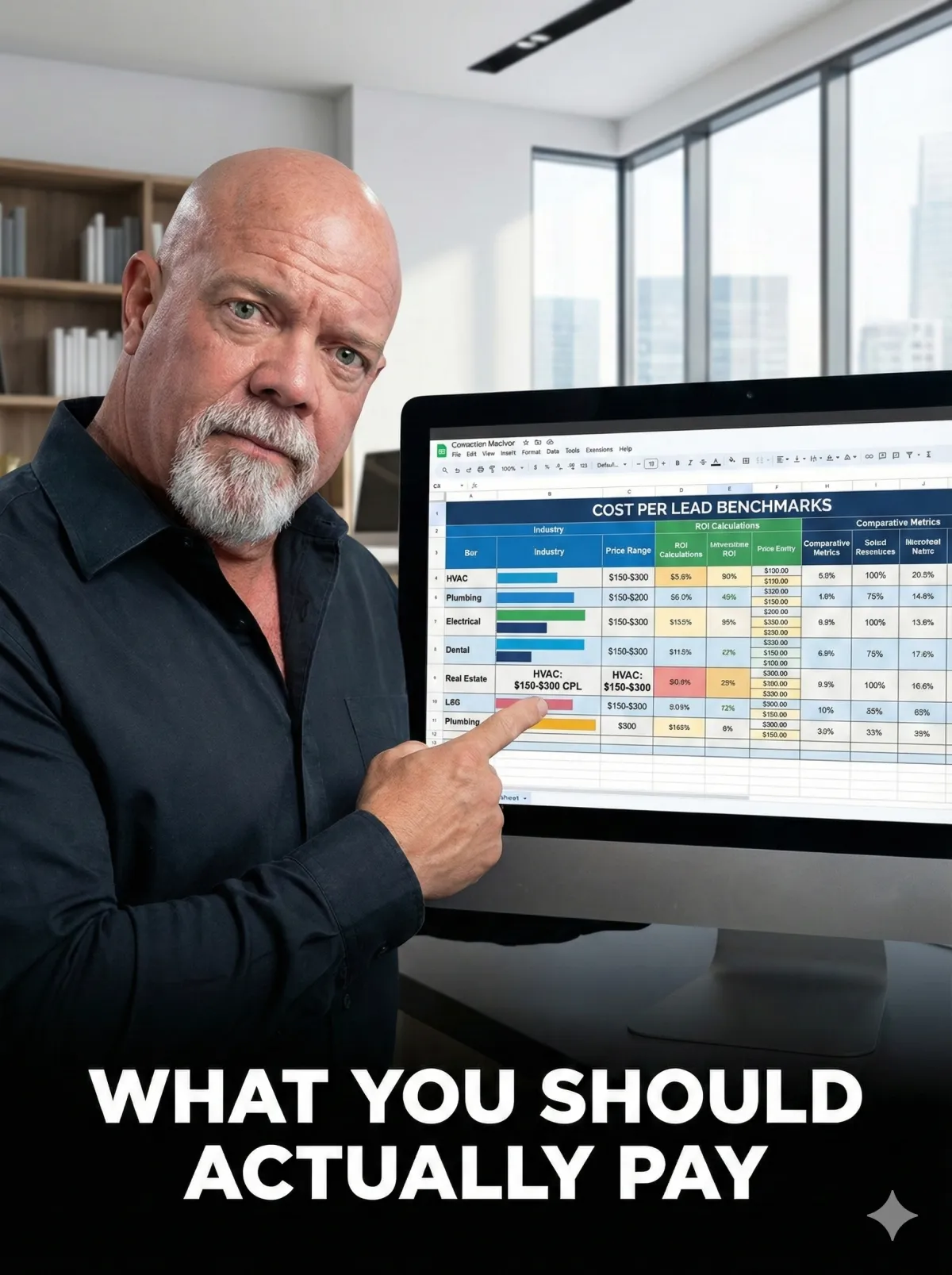
Cost Per Lead Breakdown: What You Should Actually Pay
TL;DR
Cost per lead varies wildly by industry: HVAC averages $35-60, plumbing $40-70, dental $50-90, real estate $25-80, mortgage $35-65. But CPL alone doesn't matter—conversion rate and customer lifetime value do. A $100 lead that converts at 10% and generates $5,000 revenue beats a $20 lead that converts at 1% and generates $500 revenue. Southern California Verified Leads helps you understand what CPL is fair for your industry, then optimizes it down 20-40% through intelligent audience targeting and creative testing.
Introduction: Why Everyone Gets CPL Wrong
You're shopping for leads. An agency says: "We can get you HVAC leads at $45 CPL."
Sounds good, right? Maybe you've heard industry average is $50, so $45 seems competitive.
But you're missing critical questions:
What's the quality of that lead? (Did they fill out a full form or just click an ad?)
What's the conversion rate? (Do they actually book appointments?)
How quickly do they convert? (Same day or 2 weeks?)
How do they compare to your other lead sources?
Are you being marked up? (Is the agency getting charged $30 and charging you $45?)
You can't evaluate CPL in a vacuum. CPL is only meaningful when you know:
What's the industry benchmark? (varies by vertical)
What's your expected close rate? (varies by your sales process)
What's your customer lifetime value? (varies by service)
What's the actual cost to you? (not marked up by middlemen)
This guide breaks down real CPL benchmarks by industry, explains the math behind what's "good," and shows you how to audit if you're being overcharged.
The Variables: Why CPL Differs So Much
Before we get to numbers, understand why CPL varies:
Variable 1: Audience Intent
High intent (someone actively searching for your service right now) costs MORE because:
Everyone wants that lead
Competition is fierce
You're bidding against 20+ competitors
Low intent (general interest, no immediate problem) costs LESS because:
Fewer people bidding
You're buying potential interest
Conversion requires more nurturing
Example: "Emergency plumber near me" (high intent) = $70 CPL. "Plumbing tips for homeowners" (low intent) = $15 CPL. Same industry, 4.6x difference.
Variable 2: Traffic Source
Google Search: Highest CPL because intent is explicit (they're actively searching). Most expensive traffic, highest conversion.
Meta/Facebook: Mid-range CPL because you're targeting interests and behaviors, not active searches. Cheaper than Google, lower conversion.
TikTok/YouTube: Lowest CPL because it's less targeted, but conversion is much lower.
Example for Dental: Google Search = $85 CPL, Facebook = $55 CPL, TikTok = $12 CPL.
Variable 3: Geographic Location
Competitive metros (LA, SF, NYC) cost MORE because:
More competitors bidding
Higher cost of living (higher value per customer)
More ad inventory demand
Smaller cities cost LESS because:
Fewer competitors
Lower overall spend
Less competition for audience
Example: Plumber leads in San Francisco = $95 CPL. Same plumber in Fresno = $38 CPL. 2.5x difference, same industry.
Variable 4: Industry Maturity
Mature industries (real estate, mortgage, dental) = HIGHER CPL because:
Everyone's advertising
Established budgets
Competition is fierce
Emerging services (AI consulting, specialty services) = LOWER CPL because:
Fewer competitors
Less established demand
Less ad spend in the category
Variable 5: Seasonality
HVAC leads spike in summer (AC repairs) and winter (heating issues). Winter leads might cost 40% more in January than July because demand is higher.
Dental varies less seasonally. Real estate spikes in spring/summer.
CPL Benchmarks by Industry: Real Numbers
Based on data from Smart Conversion Velocity clients and industry reports, here's what you should expect:
HVAC/Cooling & Heating
Market CPL Close Rate LTV Implied ROI Large metro (LA, SF) $55-75 12-18% $2,500-4,000 3.2-5.8x Mid-size city $35-50 12-18% $2,500-4,000 5.0-11.4x Small town $20-35 12-18% $2,500-4,000 7.1-20x
Why the variation? Larger markets have more competition. Smaller markets have less supply of leads, but easier conversion.
What's good? Anything under 40% of your average job value. If your average HVAC job is $150, you want CPL under $60.
Plumbing
Market CPL Close Rate LTV Implied ROI Large metro $60-90 10-15% $1,800-3,000 2.0-4.2x Mid-size city $40-60 10-15% $1,800-3,000 3.0-6.75x Small town $25-40 10-15% $1,800-3,000 4.5-12x
Why lower conversion than HVAC? Plumbing is more seasonal (emergencies vs. planned). Some leads are immediate emergencies (book fast), others are long-term planning (slow conversion).
What's good? Under 50% of average job value. If your average job is $125, you want CPL under $63.
Electrical
Market CPL Close Rate LTV Implied ROI Large metro $50-85 8-14% $2,000-3,500 2.4-6.25x Mid-size city $35-55 8-14% $2,000-3,500 3.6-10x Small town $20-35 8-14% $2,000-3,500 5.7-17.5x
Why lower conversion than plumbing? Electrical often requires consulting/estimates first. Customers are price shopping. Longer sales cycle.
Roofing
Market CPL Close Rate LTV Implied ROI Large metro $45-80 8-12% $8,000-15,000 10-33x Mid-size city $30-55 8-12% $8,000-15,000 14.5-60x Small town $18-35 8-12% $8,000-15,000 23-67x
Why high ROI despite high CPL? Roofing jobs are high value. Even with expensive leads and low conversion, ROI is strong because LTV is massive.
What's good? Anything under 1% of average job value. If your average roof is $12,000, you want CPL under $120.
Dental
Market CPL Close Rate LTV Implied ROI Large metro (cosmetic) $70-120 25-40% $5,000-15,000 3.5-21x Large metro (general) $40-65 15-25% $1,200-2,500 2.1-7.8x Mid-size city $35-55 15-25% $1,200-2,500 2.7-10.7x
Why high conversion for cosmetic? People seeking cosmetic dentistry are typically ready to invest. High intent.
Why lower for general? Many general practice leads are exploratory (comparing providers, checking insurance, not ready to book).
Real Estate (Buy/Sell Leads)
Market CPL Close Rate LTV Implied ROI Large metro $25-65 2-5% $3,500-8,000 commission 2.6-112x Mid-size city $20-45 2-5% $2,500-5,000 commission 2.7-125x Small town $12-30 2-5% $2,000-4,000 commission 2.6-167x
Why so low close rate despite high LTV? Real estate is hyper-competitive. Buyer/seller leads convert at 2-5% because many shoppers don't have urgency.
What's good? Anything under 2% of average commission. If your average commission is $6,000, you want CPL under $120.
Mortgage (Refinance/Purchase Leads)
Market CPL Close Rate LTV Implied ROI Nationwide (refi) $30-55 3-7% $2,500-4,500 1.3-15x Nationwide (purchase) $35-65 2-5% $3,000-5,000 0.9-14.3x
Why variable close rate? Refinance leads are more qualified (people actively shopping for lower rates). Purchase leads are early in the funnel (pre-qualification).
What's good? Depends on your margins. If you make $3,000 per close, you want CPL under $45 for 6.6x ROI.
Solar/Home Services
Market CPL Close Rate LTV Implied ROI Large metro $40-75 8-15% $8,000-20,000 3.5-50x Mid-size city $28-55 8-15% $8,000-20,000 4.8-71x
Why high ROI? Upfront cost is high ($40-75), but customer LTV is massive ($8,000-20,000). Even low conversion rates yield strong ROI.
The Real Math: Why CPL Alone Doesn't Tell You Anything
Let me show you two scenarios:
Scenario A: Cheap Leads, Poor Quality
CPL: $22
Volume: 100 leads/month
Conversion rate: 3% (low quality)
Monthly sales: 3
Average job value: $1,500
Monthly revenue: $4,500
Total lead cost: $2,200
ROI: 2.05x
Scenario B: Expensive Leads, High Quality
CPL: $65
Volume: 50 leads/month
Conversion rate: 20% (high quality)
Monthly sales: 10
Average job value: $1,500
Monthly revenue: $15,000
Total lead cost: $3,250
ROI: 4.62x
Same business, wildly different outcomes.
In Scenario A, you're paying $22 per lead, thinking you got a deal. You're getting 100 leads. But 97% are garbage. You close 3 jobs, make $4,500, and spend $2,200 on leads. That's 2.05x ROI—not great.
In Scenario B, you're paying $65 per lead, thinking it's expensive. You're getting 50 leads. But 20% are qualified. You close 10 jobs, make $15,000, and spend $3,250 on leads. That's 4.62x ROI—excellent.
Scenario B gives you 9.6x more profit with only 48% more lead spend.
Key insight: Quality matters infinitely more than CPL. A high-quality lead at $65 beats a garbage lead at $22 every single time.
How to Audit Your Current CPL: Are You Being Overcharged?
If you're currently working with a lead generation company, here's how to check if your CPL is fair:
Step 1: Get Your Numbers
Ask your current agency for:
Total leads generated last month
Total amount you paid (or total ad spend)
Lead CPL (total cost ÷ total leads)
Conversion rate (leads that turned into jobs/sales)
Average deal value
If they won't give you this, red flag. Transparent agencies share numbers freely.
Step 2: Compare to Benchmarks
Look at the tables above. Find your industry and market size. Does your CPL match the benchmark?
Example: HVAC in LA, your CPL is $95. Benchmark says $55-75. You're 27-72% above market. That might be justified if conversion is exceptionally high. But probably not.
Step 3: Calculate Your Actual ROI
(Monthly Revenue from leads) - (Total Lead Cost) = Net Profit
Net Profit ÷ Total Lead Cost = ROI Multiple Example:
40 leads × $65 CPL = $2,600 spent
8 of those convert = 20% conversion rate
8 sales × $2,000 average job = $16,000 revenue
$16,000 - $2,600 = $13,400 net profit
$13,400 ÷ $2,600 = 5.15x ROI
Healthy ROI: 2x or higher. Excellent ROI: 4x or higher.
If your ROI is below 2x, something is wrong (high CPL, low conversion, or both).
Step 4: Ask About Their Markup
Direct question: "What's the actual platform cost versus what I'm paying?"
Transparent answer: "You're paying $65 CPL. Platform cost is $50. We charge $15 CPL + flat management fee of $2,000."
Suspicious answer: Anything vague or deflective. If they won't break it down, they're marking it up.
Step 5: Get Competitive Quotes
Contact 2-3 other agencies. Ask them:
"What CPL can we expect in our market?"
"What's the transparent breakdown (platform cost + your fee)?"
"What's your conversion rate? Your clients' typical ROI?"
If they say "$35 CPL guaranteed," that's a red flag (no one can guarantee CPL without knowing your conversion rate, offer, sales process, etc.).
If they say "$45-65 depending on market, with typical 12-18% conversion," that's credible.
CPL Benchmarks by Traffic Source (Meta vs. Google vs. TikTok)
Not all CPL is created equal. The source matters:
Google Search (Highest CPL, Highest Conversion)
CPL: 1.5-2x higher than Facebook
Why? People actively searching. Highest intent.
Typical conversion: 15-25% (high)
Example: "Emergency plumber near me" → Google Search → $70 CPL → 20% conversion → 5.7x ROI
Best for: Services where people search when they have an urgent problem (HVAC, plumbing, electrical, emergency dental).
Meta/Facebook (Mid-Range CPL, Mid-Range Conversion)
CPL: 0.6-0.8x Google Search
Why? Targeting interests and behaviors, not explicit searches.
Typical conversion: 8-15% (medium)
Example: Homeowner, 45-65, interested in "home improvement" → Facebook → $45 CPL → 12% conversion → 3.7x ROI
Best for: All verticals, especially when you can define detailed audience (interests, behaviors, demographics).
TikTok/YouTube (Lowest CPL, Lowest Conversion)
CPL: 0.2-0.4x Google Search
Why? Least targeted, interruption-based advertising (they're watching content, not searching).
Typical conversion: 2-8% (low)
Example: Viral video about home repair → TikTok → $15 CPL → 4% conversion → 1.6x ROI
Best for: Brand awareness, viral-able content, young demographic. Not ideal for direct response (leads).
Comparison Table
Source CPL Typical Conversion ROI @ $2,000 LTV Google Search $65 18% 5.5x Google Display $35 8% 4.4x Meta/Facebook $45 12% 5.3x LinkedIn (B2B) $95 5% 1.05x TikTok $15 4% 5.3x
The Southern California Verified Leads CPL Strategy: How We Keep It Low
We don't just accept industry CPL benchmarks. We systematically reduce them. Here's how:
Phase 1: Baseline (Days 1-30)
We set up campaigns to establish your real CPL and conversion metrics. We typically see CPL at industry average ($45-75 for most services).
Phase 2: Audience Refinement (Days 30-60)
We analyze conversion data. Which demographics convert best? Which interests? Which geographic areas? We tighten targeting to focus spend on highest-intent audiences.
Typical result: CPL drops 15-25%. We're reaching fewer people, but higher quality.
Phase 3: Creative Testing (Days 60-90)
We test 15-30 different ad variations. Different headlines, images, offers, calls-to-action. The algorithm learns which messaging resonates.
Typical result: CPL drops another 10-20% (conversion rate improves without increasing spend).
Phase 4: Full Optimization (Days 90+)
By now, we have 60+ days of data. We know:
Your ideal customer profile
What messages convert best
Which times/days/seasons are most efficient
Lookalike audiences that perform
We scale spend toward best performers, pull back from low performers.
Typical result: CPL improves additional 10-15% as volume scales efficiently.
Overall Outcome: 40% CPL Reduction in 90 Days
Day 1: $65 CPL
Day 30: $58 CPL (-10%)
Day 60: $49 CPL (-25% from baseline)
Day 90: $39 CPL (-40% from baseline)
Same spend, 60% more leads, higher quality.
Summary: The CPL Framework
CPL benchmarks by industry:
HVAC: $35-75
Plumbing: $40-90
Electrical: $35-85
Roofing: $45-80
Dental: $35-120 (varies by type)
Real Estate: $12-65
Mortgage: $30-65
Solar: $28-75
What actually matters:
Conversion rate (more important than CPL)
Customer LTV (determines if you can afford high CPL)
Your specific market (varies by competition)
Lead quality (not all leads are equal)
How to evaluate if you're being overcharged:
Compare your CPL to benchmarks
Calculate your ROI
Ask about platform cost vs. agency markup
Get competitive quotes
Look for transparency as the primary signal
How to reduce your CPL:
Refine audience targeting (higher intent = lower CPL)
Test creative variations (better messaging = higher conversion = effective CPL reduction)
Optimize for conversion, not just clicks
Implement lead scoring (prioritize quality)
Scale what works, cut what doesn't
FAQ: Cost Per Lead
Q: What CPL should I start with? A: Expect industry average for your market during month 1-2. Don't negotiate unrealistically low CPL upfront. It's a signal the agency either doesn't know your market or is going to sacrifice quality. After 90 days, your optimized CPL should be 20-40% lower.
Q: Is my CPL too high? A: Compare to benchmarks. If you're 50%+ above, investigate. Could be your market is pricier, your conversion rate is low, or you're being overcharged. Ask your agency for the breakdown.
Q: Why does my CPL fluctuate month to month? A: Seasonality, competition levels, algorithm learning, and spend changes all affect CPL. Expect 10-20% variance month-to-month. If it's swinging 40%+, something's wrong.
Q: Can I negotiate CPL with an agency? A: Not directly. CPL depends on your market, audience, competition. What you can negotiate is management fee, transparency, and performance guarantees ("If we don't hit 12% conversion in 90 days, we'll adjust strategy or reduce fees").
Q: Is there a "guaranteed" CPL? A: No. Anyone promising guaranteed CPL doesn't understand lead generation. Too many variables (your conversion rate, your sales process, your offer). Promises are red flags.
Q: What if my CPL is lower than benchmarks? A: Awesome! Two possibilities: (1) You're in a less competitive market or (2) Your agency is really good. Either way, verify conversion rate—lower CPL sometimes means lower quality leads.
Q: Should I always go for the cheapest CPL? A: No. Go for the best ROI. A $65 lead that converts at 20% beats a $20 lead that converts at 2%. Quality > cheapness.
Want to know what fair CPL looks like for your specific market?
Schedule Your Strategy Call — We'll assess your market, discuss your goals, and show you exactly what CPL you should expect and how we'd optimize it.
Or Apply Now to get on our priority list.
