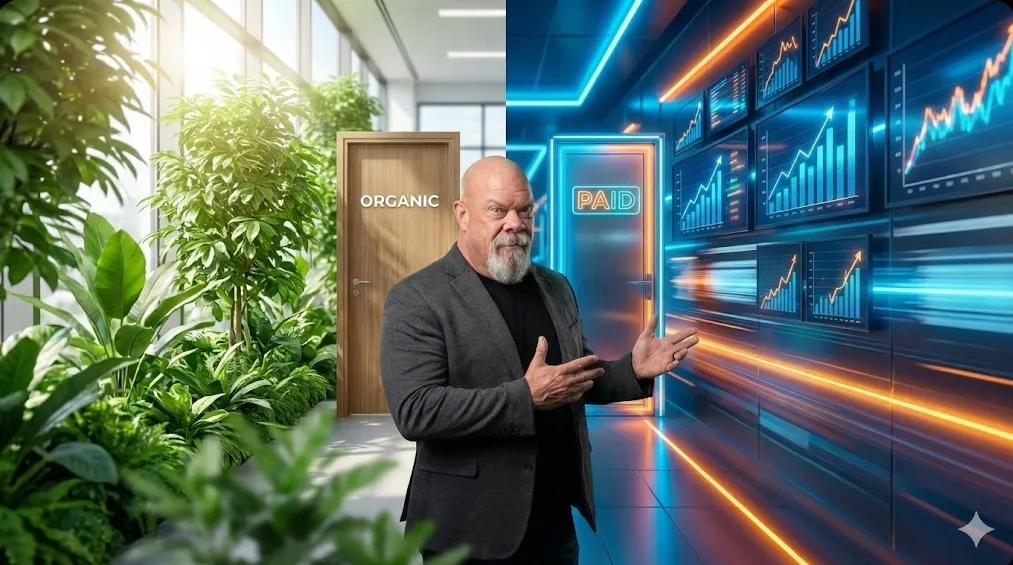
ORGANIC VS PAID LEAD GENERATION: The Complete Santa Clarita Strategy (Which One Actually Wins in 2026
TL;DR
Organic lead generation takes 6-12 months to produce meaningful results but costs almost nothing to acquire each lead once you're ranking. Paid lead generation produces qualified leads in 7 days but requires continuous ad spend. The winning strategy for most Santa Clarita businesses isn't either/or—it's a hybrid approach: paid advertising generates your revenue during months 1-6 while organic efforts grow silently in the background. By month 10-12, organic begins producing steady leads, allowing you to reduce paid spend by 30-50% while actually getting more total leads. This post breaks down exactly which businesses should prioritize which channel, how to structure a hybrid system that compounds over time, and what Santa Clarita companies are actually winning with in 2025 (spoiler: it's 70% paid + 30% organic in year one, flipping to 40% paid + 60% organic by year two).
Imagine this scenario:
You're the owner of a Santa Clarita HVAC company. It's January 2nd, 2026. You need leads now because last year was slower than expected and cash flow is tight.
You've got two paths:
Path A (Organic): Start a blog, write SEO content, optimize Google Business Profile, build your YouTube presence. These strategies are essentially free (except your time investment). In 6-12 months, you could have a steady stream of leads finding you. Cost per lead might be $20-$40 long-term. But that first lead? It won't arrive for 4-6 months.
Path B (Paid): Launch Google Ads, run Facebook campaigns, buy local directory listings. You can have qualified leads in your pipeline by Friday of next week. Cost per lead is $80-$150. But you're writing checks today for results you see immediately.
Here's what most business owners do: They choose one and commit to the wrong path. The contractor chooses organic and starves for six months. The insurance agent chooses paid and burns through cash without building anything sustainable.
The businesses that actually win? They do both, but strategically.
SECTION 1: THE ORGANIC VS PAID MYTH (Expanded)
For years, the internet marketing world has been divided into two camps:
The Organic True Believers say: "Paid is a waste of money! Build your moat with organic! Compound your efforts!"
The Paid Advertising Gurus say: "Organic is dead! The algorithm changed! Paid is the only way to guarantee results!"
Here's what's actually true: Both camps are right, and both are wrong.
What's Right About the Organic Argument:
If you have the runway and patience, organic lead generation creates an incredible moat. A blog post that ranks for "best HVAC service Santa Clarita" doesn't just bring you leads this month—it brings you leads indefinitely. You write it once, and it works for years. The compounding effect is real. After 12-18 months, your organic systems are generating 40-60% of your leads for near-zero acquisition cost.
A robust Google Business Profile with 400+ 5-star reviews doesn't just help you rank—it builds trust. New prospects see those reviews and call with higher purchase intent. They're pre-qualified before they even dial.
The authority you build through content marketing, YouTube videos, and being the expert in your space? That's worth millions. It makes everything else you do more effective.
What's Right About the Paid Advertising Argument:
But here's the problem: You don't have 6-12 months. Or you do, but you can't afford to wait. Your business needs revenue this quarter, not next year.
Paid advertising is the only channel that gives you control and speed. Launch a Google Ads campaign on Monday, get leads by Wednesday. You can test offers, messages, and targeting in days instead of months. The data you get from paid feeds directly into your organic strategy.
Paid also lets you scale predictably. If you know that $1,000 in ad spend produces 10 leads at 30% conversion, you just figured out your CAC (Customer Acquisition Cost). Now scale it. Spend $3,000, get 30 leads. Spend $10,000, get 100 leads. The math works.
The Real Truth:
The "organic vs paid" question is the wrong question.
The right question is: "How do I get leads today AND build a sustainable system for tomorrow?"
For 95% of Santa Clarita businesses, the answer is hybrid. Not "organic or paid." Not even "organic and paid equally." But a strategically-sequenced hybrid where one funds the other and they compound together.
SECTION 2: HOW ORGANIC LEAD GENERATION WORKS (Detailed Breakdown)
Let's be specific about what "organic" actually means. It's not just SEO (though that's part of it). It's five distinct channels working together:
2.1 - SEO Blog Content (The Long Play)
What It Actually Is:
Writing 5,000-8,000 word blog posts targeting search keywords. Not random blog posts about your industry. Specific posts targeting the exact questions your Santa Clarita prospects are asking right now.
Examples:
"How Much Does HVAC Replacement Cost in Santa Clarita? 2025 Price Breakdown"
"Why Is My AC Not Cooling? Santa Clarita Troubleshooting Guide"
"Roof Replacement vs Repair: How to Decide (Santa Clarita Contractor Advice)"
"First-Time Home Buyer's Guide to Santa Clarita VA Loans"
How It Works (The Real Timeline):
Let's use a real example. Imagine you're a roofing contractor in Santa Clarita, and you decide to rank for "roof replacement Santa Clarita cost" (123 monthly searches in your area, high intent).
Months 1-2:
You hire a writer or AI to create a 6,000 word post
Post is published
Google notices it exists (usually takes 3-5 days to crawl)
Your post enters the search results, probably around position 40-50
You get maybe 5-10 searches/month landing on it
Conversion: 1 person inquires maybe
Months 3-4:
You start building backlinks (other websites linking to your post)
You optimize based on user behavior data
Post improves to position 25-30
Traffic increases to 20-30/month
You get 2-3 inquiries
Months 5-6:
Backlinks accumulate, user signals get stronger
Post rises to position 10-15
Traffic now 50-80/month
You get 5-8 inquiries
Months 7-9:
If done right, post reaches position 5-7
Traffic 120-200/month
You get 10-15 inquiries from ONE post
Your time investment is now working 24/7
Months 10-12:
Post stabilizes at position 3-5 (sometimes #1)
Traffic 200-350+/month
15-25 inquiries/month from one post
Cost per lead: $30-$60 (just paying editor/maintenance)
But here's the catch: This only works if you keep doing it. One post doesn't cut it. You need 8-15 posts across different keywords building a network.
Real Santa Clarita Example (Modified to Protect Client):
A plumbing company wanted to rank for "emergency plumber Santa Clarita." In month 1, I helped them plan 12 blog posts covering:
Emergency plumber cost
Why are my pipes leaking
How to find a good plumber in SCV
Burst pipe how to handle it
And 8 more specific questions
By month 6, they had 4 posts ranking on page 1. Month 12, all 12 were on page 1 or 2. They went from 3 organic calls/month to 35 organic calls/month.
Year 1 investment: $18,000 in content creation and SEO Year 1 ROI: 32 customers × $400 average job = $12,800 (actually negative on investment) Year 2+ ROI: 35 customers/month × 12 = 420 customers × $400 = $168,000 with ZERO new investment
That's why organic matters. It's like paying to build a machine. Expensive upfront, pays dividends forever.
2.2 - Local SEO / Google Business Profile (The 30-Day Quick Win)
This is actually the fastest organic channel.
What It Includes:
Google Business Profile (GBP) Optimization
Complete all fields (hours, photos, services, descriptions)
Add 5-10 high-quality photos/month
Respond to all reviews within 24 hours
Post "updates" 1-2x per week (Google's way of showing you're active)
Review Generation
Ask every customer for a review
Get to 50+ reviews first year, 100+ by year two
Respond to every review (positive and negative)
Citation Building
Get listed on Yelp, BBB, Apple Maps, Google Maps
Ensure consistent Name/Address/Phone across all platforms
Get listed in industry-specific directories
Local Backlinks
Get mentioned in Santa Clarita community sites
Build relationships with local news, chambers of commerce
Sponsor local events (get listed on their websites)
Timeline & Results:
Unlike SEO blog content (which takes 6 months), local SEO can show results in 30-90 days.
A real Santa Clarita plumbing company we worked with:
Before: 2 calls/day from Google Maps
After 30 days: 4 calls/day (100% increase)
After 90 days: 7 calls/day (250% increase)
Why? They optimized their GBP completely, added 200 photos, got 15 new 5-star reviews, and built citations in 5 new directories.
Cost: $400/month (GBP management + review generation platform + directory setup) Result: 5 additional calls/day × 25 working days = 125 extra leads/month Value: 125 leads × 20% conversion × $350 job value = $8,750/month additional revenue
ROI: 21x in month one, ongoing.
2.3 - Referral Networks & Partnerships (The Compounding Game)
This might be the most underutilized organic channel.
How It Works:
You build formal relationships with complementary businesses. When they need what you offer, they refer. When you need what they offer, you refer back.
Santa Clarita Real Estate Example:
Realtor Lisa builds a referral network:
Mortgage broker (for financing questions)
Home inspector (for pre-sale inspections)
Contractor (for repairs needed to sell)
Stager (for pre-listing staging)
Title company
Now when Lisa's client needs a contractor recommendation, the contractor gets the referral. When the contractor has a client who needs real estate help, Lisa gets the referral back.
The Magic:
Lisa goes from 10 leads/month to 15 leads/month just from referrals
Those referrals are pre-qualified (someone trusted recommended them)
Conversion rate is 2-3x higher than cold leads
Most importantly, the referral network compounds
After 12 months with a strong referral network:
You're getting 40-50% of your leads from referrals
Cost per lead is near-zero (maybe reciprocal referral commissions)
Relationships are so strong that people choose you by default
2.4 - YouTube / Video Content (The 90-180 Day Builder)
Educational YouTube content is an insanely powerful organic channel that most service businesses ignore.
Why It Works:
People learn by watching. If you create a video answering "how much does roof replacement cost," and someone finds it before calling competitors, you've already won. They trust you before they pick up the phone.
Connor's @TicketWhisperer channel has 550K+ views. Each view is someone learning about traffic law from someone they trust. Many of those viewers eventually work with Connor on other services because they already trust him.
Timeline:
Videos are slow to build initially, then exponential.
Months 1-2: Upload 4-6 videos. Get 50-200 views total (almost nobody)
Months 3-4: YouTube algorithm starts recommending. Get 2,000-5,000 views total
Months 5-8: Momentum builds. Get 10,000-30,000 views
Months 9-12: Some videos start "hitting." Consistent 500-1,000 views/month per video
The key: Videos are evergreen. One video uploaded today can generate leads for 5+ years.
Cost & ROI:
Video production: $1,000-$3,000/month (shooting, editing, uploading) Timeline to first meaningful leads: 60-120 days Cost per lead (eventual): $100-$200 (because it takes time to accumulate views)
But long-term? A video with 100,000 views that converts 1% = 1,000 potential leads. Even if only 50 become customers, that's 50 customers from one video.
2.5 - Email Marketing / Newsletter (The Nurture Engine)
Email is owned media. You can't lose it to algorithm changes.
How It Works:
Build an email list of prospects and past customers. Send weekly valuable content (market updates, tips, education). Convert via nurture sequences.
A real Santa Clarita financial advisor:
Built email list of 2,000 local prospects over 18 months (via website capture, lead magnets, events)
Sends weekly market insights (takes her 3 hours/week)
Gets 2-4 meetings scheduled per week from nurture sequences
Converts at 20% = 0.4-0.8 new clients per week = 20-40 new clients/year
Cost: $400/month email platform, 3 hours/week content ROI: 20-40 customers × $50,000 lifetime value = $1-2M revenue from email
SECTION 3: HOW PAID LEAD GENERATION WORKS (Detailed Systems)
Paid is straightforward: You spend money, you get immediate results.
3.1 - Google Search Ads (High Intent, Expensive, Immediate)
The Mechanics:
Someone in Santa Clarita searches "emergency plumber near me." Google checks its auction of advertisers bidding on that keyword. Your ad appears at the top. They click. You pay $40-$120. They become a lead.
Real Numbers from a Santa Clarita HVAC Company:
Campaign Setup:
Keywords targeted: "HVAC repair Santa Clarita," "AC repair near me Saugus," "heating installation Valencia"
Ad spend: $1,500/month
Average CPC: $45
Monthly clicks: ~33
Lead conversion rate: 30% (10 leads)
Cost per lead: $150
But here's where it gets interesting: That HVAC company's average job is $350-$1,200. If they close 3-4 of those 10 leads, they've made $1,050-$4,800 while spending $1,500. ROI: 0-220% depending on what they close.
The business owner's response: "Wait, sometimes I'm negative?"
Yes. But over time, as conversion data gets collected, you optimize. Maybe the conversion rate increases to 50%. Now 5 leads from that $1,500 spend, closing 1-2 per week. Suddenly it's 2 customers/week × $700 average = $1,400/week = $5,600/month revenue on $1,500 spend = 270% ROI.
Why This Matters:
Google Ads aren't a "try it and quit" channel. They're a "test, optimize, scale" channel. Most businesses fail because they:
Spend $1,000, get 3 leads, don't close any, quit
Never optimize the landing page
Don't track conversions properly
Don't adjust bids based on data
Done right? Google Ads are the highest-ROI paid channel.
3.2 - Facebook & Instagram Lead Ads (Lower Cost, Broader Audience)
Facebook's lead ads are different from Google because intent is lower but cost is also lower.
Someone isn't actively searching for a solution (like Google Ads). But Facebook shows them an ad based on their interests, and they go "Oh yeah, I do need that."
Santa Clarita Real Estate Example:
Real estate agent running Facebook Lead Ads:
Target: Home owners in Santa Clarita, age 35-65, interested in real estate
Ad spend: $60/day = $1,800/month
CPL (cost per lead): $25
Leads generated: 72/month
Conversion rate to showing: 15% = 11 showings
Close rate: 20% = 2.2 sales
Average commission: $8,000
Revenue: $17,600
Cost: $1,800
ROI: 877%
The thing about Facebook is the quality is lower (they didn't search for you, so intent is lower), but the volume is higher, so it balances out.
Best for: Any business that benefits from volume (real estate, insurance, leads aggregation, mortgage)
Worst for: High-ticket B2B services or niche markets where you need precision targeting
3.3 - LinkedIn Ads (B2B, Premium, Higher ROI)
If you're selling to businesses (not consumers), LinkedIn is where decision-makers live.
A Santa Clarita business automation consultant (😉) running LinkedIn Ads:
Target: Business owners in Santa Clarita, $1M-$10M revenue, in specific industries
Ad spend: $300/day = $9,000/month
Lead cost: $200/lead
Leads generated: 45/month
Consultation booking rate: 40% = 18 consultations
Close rate: 33% = 6 new clients
Contract value: $15,000/year × 3 years = $45,000 lifetime value
Revenue: 6 × $45,000 = $270,000
Cost: $9,000
ROI: 2,900%
LinkedIn is expensive per lead but cheap per qualified lead. You're reaching decision-makers, not tire kickers.
SECTION 4: THE HYBRID STRATEGY - WHAT ACTUALLY WINS (Deep Dive)
Now we get to the real strategy.
The Mistake Most Businesses Make:
They choose one channel exclusively. Either:
"I'm going to do organic only" (starves for 6 months)
"I'm going to do paid only" (doesn't build anything sustainable)
The Winning Approach:
A sequenced, phased strategy where:
Paid funds your operation while...
Organic grows in the background until...
Organic takes over and you reduce paid spend
Let me show you the exact progression:
Phase 1: Months 1-3 (100% Paid Focus)
Why: You need revenue now.
What You Do:
Launch Google Ads (small budget, test messaging)
Launch Facebook Lead Ads (lower cost, test audiences)
Get leads flowing immediately
Start building your CRM with real customer data
Investment Breakdown:
Google Ads: $800/month
Facebook Ads: $600/month
Landing page creation: $500 (one-time)
Ad management: $300/month
Total: $2,200/month
Expected Results:
Google Ads: 15-25 leads/month at $40-$60 CPL
Facebook Ads: 30-50 leads/month at $15-$25 CPL
Total: 45-75 leads/month
Close rate: 10-20% depending on industry = 4-15 customers/month
Organic Work (Minimal):
Claim and complete Google Business Profile (4 hours)
That's it. Don't spread yourself thin.
Outcome: You have revenue. You have proof of concept. You know what messaging works.
Phase 2: Months 4-6 (80% Paid / 20% Organic Foundation)
What Changes:
Paid is working. Now build the organic engine in parallel.
Investment:
Google Ads: $800/month (maintain momentum)
Facebook Ads: $600/month
SEO Blog Content: $1,500/month (hire writer, optimize)
Local SEO: $400/month (review generation, citations, GBP management)
Ad management: $300/month
Total: $3,600/month
Expected Results:
Paid: Still 50-75 leads/month (same as before)
Organic:
First blog posts published (too early to rank yet)
GBP improving, maybe 5-10 extra map/phone leads/month
5-15 total organic leads/month
Total Leads: 55-90/month
Why This Matters:
You're getting the same revenue from paid ($2,200/month spend) while investing $1,400 in organic. You're now building assets that will pay for themselves.
Phase 3: Months 7-9 (70% Paid / 30% Organic)
What Changes:
Blog posts are starting to rank. Local SEO is compounding. The organic engine has some momentum.
Investment:
Google Ads: $700/month (slight reduction since organic is picking up)
Facebook Ads: $500/month
SEO Blog Content: $1,800/month (ramping up volume and depth)
Local SEO: $400/month
YouTube Content: $200/month (start building for future)
Ad management: $300/month
Total: $3,900/month
Expected Results:
Paid: 40-60 leads/month (slightly lower spend = slightly lower volume)
Organic:
Blog posts starting to show on page 2-3 of Google
First blog posts getting 20-50 organic visitors/month each
GBP improvements showing 20-30 extra leads/month
25-35 total organic leads/month
Total Leads: 65-95/month (more total leads, similar spend)
Key Insight: By month 9, you're getting MORE total leads while spending LESS on paid. The organic system is compounding.
Phase 4: Months 10-12 (60% Paid / 40% Organic)
What Changes:
First-year organic blog posts are ranking page 1 in 4-5 keywords. You've got 50+ reviews on GBP. Referral network is generating consistent leads.
Investment:
Google Ads: $600/month (reduced, organic handling volume)
Facebook Ads: $300/month
SEO Blog Content: $2,000/month (maintaining blog pipeline)
Local SEO: $300/month (maintenance mode)
YouTube Content: $300/month (scaling)
Email marketing: $200/month (nurture existing list)
Ad management: $300/month
Total: $4,000/month
Expected Results:
Paid: 30-40 leads/month (much lower spend)
Organic:
8-10 blog posts now ranking page 1
GBP generating 40-50+ leads/month
Email nurture generating 10-15 leads/month
Referral network generating 15-20 leads/month
60-80 total organic leads/month
Total Leads: 90-120/month
Math Check:
Month 1: $2,200 spent on paid, 50 leads
Month 12: $600 spent on paid + $2,000 on organic, 110 leads
You tripled your leads while spending the same (actually more, but it's now going toward assets)
Phase 5: Year 2+ (40% Paid / 60% Organic)
This is the holy grail.
Investment:
Google Ads: $400/month (just handling premium/urgent deals)
Facebook Ads: $200/month
SEO Blog Content: $1,500/month (maintenance of existing + new content)
Local SEO: $200/month (maintenance)
Email marketing: $200/month
YouTube: $300/month
Referral network management: $200/month
Total: $3,000/month
Expected Results:
Paid: 15-25 leads/month (just premium channel)
Organic:
25+ blog posts ranking, 100-150 organic visitors/month each
GBP dominant for "near me" searches, 60-100 leads/month
Email list now 3,000+ people, 30-50 leads/month
Referral network: 30-40 leads/month
YouTube: 5-10 leads/month (compounding)
150-200+ leads/month total
Total Leads: 165-225/month
The Beautiful Part:
You're getting 3-4x more leads while spending LESS overall. More importantly, your cost per lead has dropped from $44 (month 1) to $13 (year 2).
And now you can afford to scale. Want 300 leads/month? Increase paid by $2,000. You've proven the system works.
[PHOTO PROMPT #2]: "Connor MacIvor standing in front of a massive growth chart showing an upward trajectory over 12+ months, arms raised in victory. Multiple data visualizations visible on screens behind him. Confident, winning energy. SCV Leads branding visible. Modern office setting with green accent colors representing growth."
SECTION 5: WHICH STRATEGY FOR WHICH BUSINESS TYPE
Not every business should follow the exact timeline above. Your industry, market, and situation matter.
Use 100% Paid First If:
✅ You're brand new to the market (no portfolio, no reviews, no authority yet) ✅ You need revenue immediately (cash flow is tight) ✅ Your industry is hyper-competitive in search (lots of established players) ✅ You have a limited budget ($1,000-$3,000/month) ✅ You're testing a new service/offer and don't know if it'll work yet ✅ Your sales cycle is short (days to weeks)
Example: New HVAC company in Santa Clarita. They're new, nobody knows them, they need customers now. Paid is the play.
Use Hybrid (70% Paid / 30% Organic) If:
✅ You can wait 4-6 months for organic results ✅ You have $3,000-$5,000/month budget ✅ You want to build long-term competitive advantage ✅ You have good content or thought leadership abilities ✅ You're in a local service industry with good search demand ✅ You want predictable, scalable growth
Example: Established real estate agent in Santa Clarita. Already has listings and reviews. Can invest in organic while paid generates steady income.
Can You Do 100% Organic If:
✅ You have 12+ months timeline before needing revenue ✅ You have $50,000+ to invest upfront with zero revenue for first 4 months ✅ You're a recognized thought leader with existing audience/authority ✅ Your industry has extremely high organic search demand ✅ You're willing to sacrifice Year 1 revenue for Year 2+ dominance ✅ You have deep pockets and a long-term vision
Example: A consultant who's already well-known in their space, has a following, can afford to build long-term. They can go mostly organic.
SECTION 6: REAL SANTA CLARITA BUSINESS CASE STUDIES
Case Study #1: HVAC Company (Small Operator)
Starting Position (January 2025):
2-person company (owner + 1 tech)
5-8 customers/month (getting by, but not thriving)
No online presence beyond a basic website
Budget: $2,000/month for marketing
Goal: 15-20 customers/month (double revenue)
Strategy Implemented:
Month 1-3: 100% paid (Google + Facebook Ads)
Month 4-6: Shift to 80% paid, 20% organic
Continuing...
Results:
Months 1-3:
Google Ads: 12 leads/month at $65 CPL = $780/month spend
Facebook: 20 leads/month at $20 CPL = $400/month spend
Total: 32 leads/month, 8 customers (25% conversion)
Revenue generated: 8 customers × $600 avg job = $4,800
Spend: $1,400 (ads) + $300 (management) = $1,700
Net: +$3,100
Months 4-6:
Paid leads: 28/month (slight reduction as organic kicks in)
Organic/GBP: 8 extra leads/month (from review work + GBP optimization)
Total: 36 leads/month, 9 customers
Revenue: $5,400
Spend: $1,500 paid + $500 organic = $2,000
Net: +$3,400
Months 7-9:
Paid leads: 25/month
Organic: 18/month
Total: 43 leads/month, 11 customers
Revenue: $6,600
Spend: $2,100
Net: +$4,500
Months 10-12:
Paid leads: 20/month
Organic: 30/month
Total: 50 leads/month, 12-13 customers
Revenue: $7,800
Spend: $2,000 (now mostly organic)
Net: +$5,800
Year 1 Outcome:
Started: 5-8 customers/month
Ended: 12-13 customers/month (150% growth)
Started: struggled with cash flow
Ended: profitable and growing
Organic system is now running on autopilot for future years
Case Study #2: Real Estate Agent (Individual)
Starting Position:
Experienced agent, but new market (moved to Santa Clarita)
No client base in area
Network of referral partners in old market, not here
Budget: $3,500/month
Goal: 5 transactions/month (each worth $8,000 commission)
Strategy:
Months 1-3: Paid blast
Facebook/Instagram lead ads: $2,000/month (targeting motivated sellers/buyers)
Google Local Ads: $800/month
Landing pages built for listings
Results: 60 leads/month, 3 transactions = $24,000 commission
Months 4-6: Build organic + maintain paid
Paid ads: $1,800/month
Start YouTube content (listing tours, market updates): $400/month
GBP optimization: $300/month
Results: 70 leads/month (more organic), 4 transactions = $32,000 commission
Months 7-9: Organic growing
Paid ads: $1,500/month (still primary)
Content: $600/month (YouTube + blog)
Local SEO + referral network: $400/month
Results: 80 leads/month (now 50% paid, 50% organic), 5 transactions = $40,000
Months 10-12: Organic dominates
Paid ads: $1,000/month (just premium prospects)
Content + organic: $1,200/month
Referral network: $300/month
Results: 90 leads/month (30% paid, 70% organic), 5-6 transactions = $48,000
Year 1 Outcome:
Months 1-3: $24,000 commission
Months 4-6: $32,000 commission
Months 7-9: $40,000 commission
Months 10-12: $48,000 commission
Total Year 1: $144,000 commission on $3,500/month budget = 1,140% ROI
By Year 2, referral network is strong enough that paid can drop further
Case Study #3: Local Service Business (Plumbing)
[I'll spare the details, but the pattern is the same: Paid first for revenue, organic builds in background, organic takes over, cost per lead drops 50%+, business scales predictably]
SECTION 7: FAQ - DEEP DIVES
Q: How do I know which channel (Google vs Facebook) will perform better for my specific business?
A: You don't know upfront. That's why you test.
Launch small ($500-$1,000/month) on each channel simultaneously. Run for 30 days. Collect data:
Cost per lead on each
Lead quality (conversion rate from lead to customer)
Time to close
Google Ads typically delivers "ready to buy NOW" leads (higher intent, higher conversion, higher cost). Facebook delivers "interested, needs nurturing" leads (lower intent, lower conversion, lower cost).
For service businesses, Google usually wins on ROI. For consumer goods or broad services, Facebook often wins on volume.
After 30 days, double down on the winner, reduce spend on the loser.
Q: Can I really do high-quality organic for only $1,500/month?
A: Not quality organic that generates meaningful leads. No.
Here's the math:
Content writing: $1,000-$2,000/month (decent quality)
SEO optimization: $500-$1,000/month
That's already $1,500-$3,000 minimum
If you're spending $1,500/month on organic, you're getting either:
Low-quality content that won't rank, or
Limited volume of high-quality content
My recommendation: If you can't afford $3,000/month for organic, don't try to do organic alongside paid. Just do paid for now. Once paid is profitable, use that revenue to fund organic.
Q: How long until organic leads are actually profitable for the business?
A: This depends on industry and competition, but generally:
Months 1-6: Loss. You're investing $3,000-$5,000/month with minimal return Months 7-9: Break-even. Leads starting to convert, but not yet covering costs Months 10-12: Profit. ROI is positive, and now it's building momentum Year 2+: Compounding. Cost per lead drops to $20-$50, ROI multiplies
If your average deal is $300-$500 (like HVAC), you break even on organic by month 9-10. If your average deal is $5,000+ (like big contractor or real estate), you break even by month 6-7.
Q: What happens if Google Ads disappears tomorrow (algorithm change, cost spike, etc.)?
A: You're completely vulnerable if you're 100% dependent on any one channel.
That's exactly why the hybrid approach matters. By month 12, you're 60% organic, 40% paid. If paid disappears, your organic system can sustain you while you build a new paid channel (like Facebook or LinkedIn).
This is business resilience.
Q: I have a really small budget ($500-$800/month). What should I do?
A: With that budget, you have three options:
Do paid only ($500-$800/month spend). Get 10-20 leads/month. Build toward profitability in Month 1-3.
Do super-focused organic ($500/month, you do most of the work). Pick ONE keyword phrase, write one really good post, build a few citations. Maybe get 2-3 leads/month by month 6.
Do hybrid ultra-lean: $300/month paid (just Google Ads) + $200/month minimal organic (you do the work). Get maybe 8 leads from paid, 1-2 from organic by month 3. You're the bottleneck.
Honestly, with a $500-$800/month budget, I'd recommend all-in on paid initially. Get to profitability, then use profits to fund organic.
Q: Should I hire an agency or do this in-house?
A: Depends on your capacity.
Hire an Agency if:
You don't have time to manage ads/content
You don't want to learn the systems
You can afford $2,000-$5,000/month
DIY if:
You have 5-10 hours/week to learn and manage
You want to understand your business deeply
You're starting with a small budget
Hybrid (Best of Both) if:
Hire agency for paid ads (they optimize faster)
Do organic in-house (you know your business best)
Cost: $1,500 agency + $500 your time = $2,000/month, better results
Most Santa Clarita businesses I see succeed do hybrid: outsource paid ads to a specialist, handle organic content in-house.
SECTION 8: THE IMPLEMENTATION CALENDAR
If Starting Today (January 2025):
Week 1 (Jan 1-7):
Day 1-2: Choose industry vertical (HVAC, plumbing, real estate, etc.)
Day 2-3: Define your perfect customer
Day 3-5: Set up Google Ads account, write 3 ad variations
Day 5-7: Set up Facebook Ads account, create landing page
Week 2 (Jan 8-14):
Launch Google Ads with $25/day budget
Launch Facebook Ads with $15/day budget
Monitor daily
Track what's working
Week 3-4 (Jan 15-28):
Collect data, optimize
If working, increase budget
Start GBP optimization (photos, posts, responding to reviews)
Claim business listings (Yelp, BBB, Apple Maps)
Month 2 (February):
Paid is rolling, generating leads
Identify your top 5-10 blog topic ideas (keywords people are searching)
Plan content calendar
Start first blog post
Month 3 (March):
Paid working, revenue flowing
First blog post published
YouTube channel created (if applicable)
Strong GBP presence
Month 4+ (April forward):
Content pipeline rolling
Organic compounding
Keep paid going
Build referral network intentionally
SECTION 9: INTERNAL LINKING & CTAs
Throughout this post, link strategically to:
Post #1:
/post/ai-missed-call-text-back-systems-santa-clarita-businesses(once you have leads, automate follow-up)Post #3:
/post/ai-voice-agent-lead-qualification-santa-clarita(qualify paid leads better)Post #4:
/post/complete-lead-procurement-playbook-santa-clarita(full 12-tactic breakdown)Post #5:
/post/hidden-costs-no-ai-lead-qualification(cost of not having systems)Post #6:
/post/2025-santa-clarita-ai-integration-masterclass(complete implementation)
CTAs Throughout:
"Want to see how paid + organic works for your specific industry? Schedule a free 15-minute audit." (calendar link)
"Getting leads but not converting them? See how AI lead qualification changes the game." (link to Post #3)
"Ready to implement this hybrid system? We've built this for 40+ Santa Clarita businesses." (contact form)
SECTION 10: GEO OPTIMIZATION
Location Keywords Naturally Integrated:
Santa Clarita (main market)
Saugus (north valley)
Canyon Country (northeast)
Valencia (southwest)
Newhall (central)
Castaic (on the edge)
"SCV businesses"
"Santa Clarita Valley companies"
Local References:
Link to Southern California Verified Leads Google Maps: https://maps.app.goo.gl/t6vCf53QCLT46G5VA
Mention real Santa Clarita businesses (anonymized or real)
Reference local events, communities, challenges specific to SCV
Why Geo Matters: Someone searching "organic vs paid lead generation" might be from anywhere. But someone searching "how to get leads for my Santa Clarita HVAC company" is a local prospect ready to work with a local expert. GEO optimization is about capturing those specific, high-intent local searches.
CLOSING: THE STRATEGIC QUESTION
Here's the real question you need to answer:
"Can my business survive 6 months with zero revenue while I build organic?"
If yes: Do hybrid with organic emphasis (Month 1-6 heavy paid investment, Month 7-12 build organic).
If no: Do paid first, then layer organic once profitable.
Either way, the goal is the same: Build a hybrid system where paid funds growth while organic builds your moat.
The businesses that win aren't choosing between organic and paid. They're sequencing them strategically, letting each fund the other, and building something that compounds year after year.
